Oranges and lemons
The nursery rhyme that begins with the bells of St Clement’s runs through Nineteen Eighty-Four like a thread of the abolished past. It is first spoken by the junk-shop proprietor Mr Charrington, becomes a private countersign between Winston Smith and Julia, is completed by O’Brien as a sign of conspiracy, and is finally thrown back at the lovers by a hidden telescreen at the moment of their arrest. In a state where the past is continually rewritten and even the year cannot be fixed with certainty, the rhyme survives as a piece of forbidden archaeology—a remnant, in Winston’s phrase, of a lost London “disguised and forgotten.”
The Bells of St Clement’s Dane
The rhyme enters the novel through Mr Charrington, the frail, bowed owner of a junk shop, who identifies the steel engraving on his wall as St Clement’s Dane, a bombed church standing outside the Law Courts. With an apologetic smile he lets fall the first line: “Oranges and lemons,” say the bells of St Clement’s! He remembers the rhyme from his boyhood as “a kind of a dance,” in which children held out their arms for others to pass under and brought them down to catch the child at the ending “Here comes a candle to light you to bed, Here comes a chopper to chop off your head.” He can squeeze one further line from his memory—“You owe me three farthings,” say the bells of St Martin’s—and explains that a farthing was a small copper coin that “looked something like a cent.” Standing in the shop, Winston feels the words as an enchantment; he seems to hear bells from one ghostly steeple after another—“the bells of a lost London that still existed somewhere or other, disguised and forgotten”—though he cannot remember ever having heard church bells ringing in his life.
A Countersign Shared with Julia
The rhyme shadows Winston out of the shop: leaving it he hums the first two lines to an improvised tune, only to find the dark-haired girl from the Fiction Department bearing down on him, the very girl he suspects of spying. Waiting in Victory Square for their first meeting, he identifies St Martin’s church and reflects that its bells, “when it had bells,” had chimed “You owe me three farthings.” Later, in the room above Mr Charrington’s shop, he offers the opening line half-nostalgically, and Julia startles him by capping it: “You owe me three farthings,” say the bells of St Martin’s, “When will you pay me?” say the bells of Old Bailey. She remembers, too, that it ends with “Here comes a candle to light you to bed, here comes a chopper to chop off your head!”—her grandfather used to say it to her before he was vaporised when she was eight. Winston feels the two halves fall together “like the two halves of a countersign.” There is a gap inside the shared secret: Julia has seen oranges but wonders what a lemon might be, while Winston can remember lemons as common in the nineteen-fifties, so sour that the smell set one’s teeth on edge.
O’Brien’s Last Line and the Voice Behind the Picture
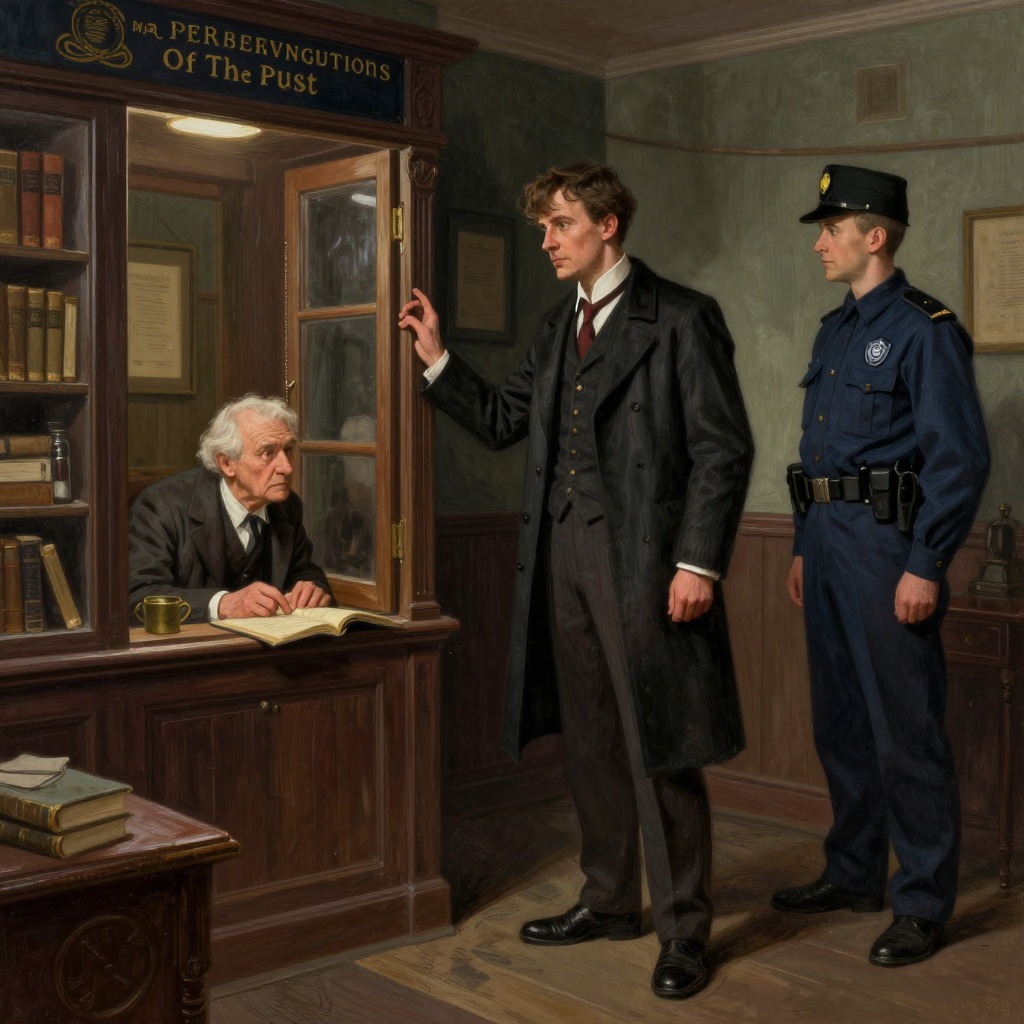
Winston carries the rhyme into the conspiracy itself. In O’Brien’s softly lit flat, after the decanter of wine and the toast to Emmanuel Goldstein, O’Brien asks what they should drink to next, and Winston answers, “To the past”; O’Brien gravely agrees that “The past is more important.” Winston then asks whether O’Brien has ever heard the old rhyme that begins with the bells of St Clement’s, and O’Brien completes it: “Oranges and lemons,” say the bells of St Clement’s, “You owe me three farthings,” say the bells of St Martin’s, “When will you pay me?” say the bells of Old Bailey, “When I grow rich,” say the bells of Shoreditch. “You knew the last line!” Winston cries. The same rhyme returns as betrayal in the room above the shop. As an iron voice from behind the picture orders the lovers to stand still, a second, cultivated voice—one Winston has the impression of having heard before—adds, “And by the way, while we are on the subject, ‘Here comes a candle to light you to bed, here comes a chopper to chop off your head!’ ” Mr Charrington, no longer wearing spectacles, his white hair turned black and his cockney accent gone, stands revealed as a member of the Thought Police.
A Relic in the War Against the Past
Writing his diary was not illegal—“nothing was illegal, since there were no longer any laws”—and yet, like the rhyme, it belonged to a world of unspoken dangers; a Party member lives from birth to death under the eye of the Thought Police, his friendships, his habits and even his dreams jealously scrutinised. Anything old, and for that matter anything beautiful, was always vaguely suspect, and the rhyme is both. It belongs to the same vanished London as the engraved church and the glass paperweight, an era in which children played at passing under the arms of their friends while singing of choppers and candles. Like that game, the rhyme joins tenderness to menace: it is the lullaby of the lovers’ secret room and the password of their destruction. It is one of the few things of the old world that Winston and Julia can share without a telescreen hearing them, and one of the few that the Party itself will speak aloud when it has won.